CIPP Specialty Service
Restore Failing Pipes From The Inside
Trenchless epoxy relining repairs cracked, root-intruded, and corroded sewer lines without digging up your property. Two access points, one continuous liner, and decades of renewed life.
Live diagram | Resin flowing through host pipe during inversion
0+
Year design life of cured CIPP liners
0-day
Typical residential install window
0%
Less surface disruption vs open trench
0%
Pre and post-install camera verification
See The Difference
Before And After, Inside The Pipe
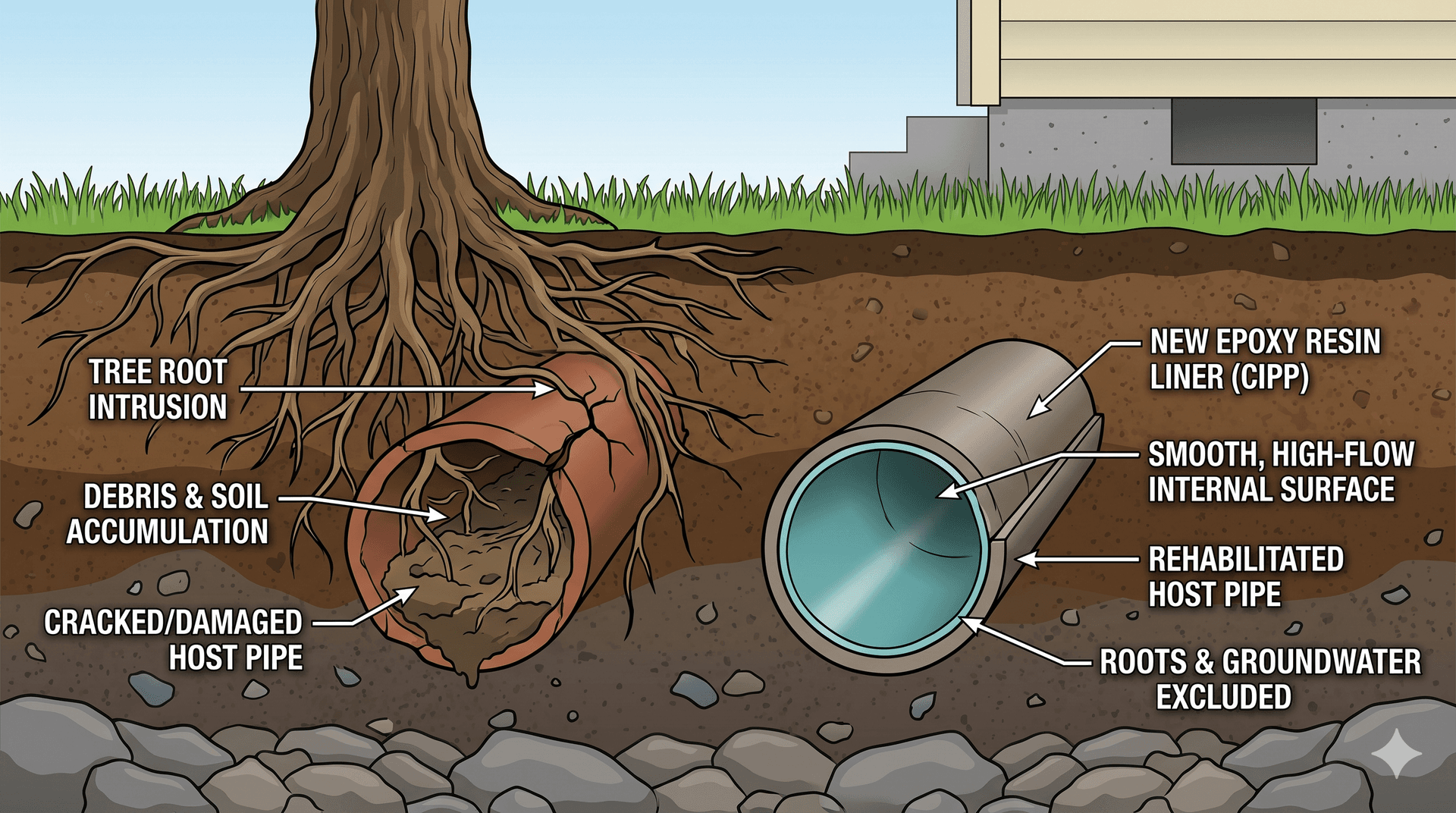
CIPP relining is a visual decision. Here is what we typically find before prep and what the same line looks like after a cured-in-place liner has been installed.
Before
Compromised host pipe
Root intrusion at joints, hairline cracks, and surface scaling reduce flow and invite recurring blockages.
After
Smooth, sealed CIPP liner
A continuous epoxy liner removes joints, seals cracks, and restores hydraulic capacity.
Field documentation
Real footage drives every recommendation
Every relining quote starts with camera evidence. You see exactly what we see, in the same resolution we used to scope the job.
CIPP Workflow
Four Steps From Diagnosis To Documented Closeout
The same sequence runs on every job. Each step has its own checkpoints so we never advance without confidence in the prior one.
Inspection and Defect Mapping
HD sewer camera inspection maps root intrusion, offsets, fractures, and transition points before we prescribe any liner plan.
- Pipe ID, depth, and material verification
- Defect log with footage-backed locations
- Flow behavior review during camera pass
Cleaning and Host Pipe Prep
We restore flow and prep the host pipe so the liner seats correctly and cures against a clean, stable interior surface.
- Root cutting and debris extraction
- Hydro-jetting for full wall prep
- Final pre-liner camera quality check
Liner Saturation and Inversion
The CIPP liner is saturated with epoxy and installed using inversion or pull-in methods selected for site geometry and service continuity.
- Epoxy wet-out and resin control
- Access strategy to minimize disruption
- Install pressure and progression tracking
Cure, Reinstate, and Verify
After cure, we reinstate active connections and deliver post-install camera verification to confirm continuity and flow.
- Controlled cure window and monitoring
- Service lateral reinstatement as required
- Post-cure QA footage and client walkthrough
Trenchless vs Traditional
Why Owners Choose Relining Over Excavation
| Factor | Open Trench | CIPP Relining |
|---|---|---|
| Excavation footprint | Trench across yard, drive, or slab | Two small access points |
| Service downtime | Multiple days | Same-day in most homes |
| Landscape restoration | Required, often costly | Minimal to none |
| Joint elimination | New joints introduced | Continuous jointless liner |
| Closeout evidence | Visual on backfill only | HD camera verification footage |
Why Relining Wins
Six Reasons Owners Pick CIPP
No-dig restoration
Two small access points instead of trenching across lawns, drives, and finished landscaping.
Structural renewal
Cured-in-place liner forms a new pressure-rated pipe inside the host, sealing cracks and joints.
Root-resistant interior
Smooth epoxy bore eliminates joints where roots typically re-enter, breaking the regrowth cycle.
Documented closeout
Pre- and post-install footage gives owners and facility teams clear evidence of work completed.
Lower lifecycle cost
Avoids restoration costs of excavation while extending pipe life decades into the future.
Faster turnaround
Most residential lines complete in a single workday, restoring service quickly.
Common Questions
What Owners Ask Before Approving Relining
How long does a relined pipe last?
Can any pipe be relined?
Does relining reduce my pipe diameter?
Will I lose service during the install?
How is this different from spot repair?
Material Stack And System Notes
Each project is matched to the host pipe condition. For deeper product-level information, Perma-Liner’s resources are a useful companion for understanding CIPP system components and process language.
External Technical Reference
Perma-Liner Official SiteCommon Defects We Target
- Root intrusion and regrowth cycles
- Longitudinal cracking
- Offset joints and infiltration points
- Surface wear in aging host pipe
Start A Relining Assessment
Share what you are seeing on site. We’ll scope inspection depth, determine CIPP feasibility, and identify where trenchless relining creates the strongest cost-to-longevity outcome.